
Collapsed Drain in Yorkshire? Signs, Causes & What to Do Next
Worried about a collapsed drain in Yorkshire? Learn the warning signs, common causes in older Yorkshire homes, and your repair options.
A collapsed drain is one of the most serious — and costly — drainage problems a homeowner can face. In Yorkshire, where a huge proportion of the housing stock was built during the Victorian and Edwardian eras, collapsed drains are a far more common discovery than most people expect. If you've noticed warning signs or you're buying an older property, understanding what a collapsed drain looks and behaves like could save you thousands of pounds.
What Is a Collapsed Drain?
A collapsed drain is a section of underground pipe that has cracked, fractured, or completely caved in, preventing waste water from flowing freely. Unlike a simple blockage — which can often be cleared by drain unblocking — a collapsed drain involves structural failure of the pipe itself. The section needs to be repaired or replaced, not just cleaned.
Collapsed drains can occur gradually over many years or suddenly, depending on the cause and condition of the pipe.
Why Are Collapsed Drains So Common in Yorkshire?
Yorkshire's housing stock is among the oldest in England. Cities like Leeds, Bradford, Sheffield, and Huddersfield are densely packed with Victorian terraces, back-to-backs, and Edwardian semis — the vast majority of which were built with vitrified clay drainage pipes. According to the English Housing Survey, around 20% of homes in England were built before 1919, and in the urban centres of West and South Yorkshire that proportion is considerably higher.
Clay pipes from the Victorian era have a design lifespan of roughly 50 to 100 years — meaning that much of Yorkshire's original drain infrastructure is well past its expected service life. These old pipes become brittle over time, making them highly susceptible to:
- Ground movement and subsidence, which is common in Yorkshire given its mix of sandstone, shale, and coal-measure geology
- Tree root ingress, which gradually forces joints apart until the pipe fails (a problem we covered in detail in our tree roots in drains guide)
- Heavy vehicle loading, particularly on older terrace streets where drains run beneath or close to vehicular access points
- Corrosion and joint failure, accelerated by decades of effluent and temperature cycling
Pitch fibre pipes — a cheaper alternative used widely in post-war Yorkshire housing built from the 1950s to the 1970s — are also a major source of collapsed drain callouts. These pipes are notorious for delaminating and collapsing inward, a failure mode that can go undetected for years.
What Are the Warning Signs of a Collapsed Drain?
What does a collapsed drain smell like?
A collapsed drain often produces a persistent foul smell indoors or in the garden, even when no drains are in use. Because the structural failure creates gaps in the pipework, sewage gases can escape directly into the soil and sometimes into the property. If you notice an unexplained sewage odour that doesn't correlate with any obvious blockage, a collapsed section should be investigated.
How does a collapsed drain affect drainage speed?
A collapsed drain causes partial or complete obstruction, so water drains slowly — or not at all — from sinks, baths, toilets, and gulley pots. The difference between a collapse and a standard blockage is that the slow drainage typically returns soon after rodding or jetting, because the physical obstruction (the crushed pipe wall) remains in place.
Can a collapsed drain cause subsidence?
Yes — and this is the most serious consequence. When a drain collapses, waste water leaks into the surrounding soil over time, washing away fine particles and creating voids beneath foundations. In Bradford, Leeds, Wakefield, and other parts of West Yorkshire, where many terraces sit on variable fill or made ground, this soil erosion process can cause visible cracking in walls and floors. A CCTV drain survey that reveals a collapse should trigger prompt investigation of the foundations, particularly in older properties.
Does a collapsed drain cause damp?
It can. Persistent ground saturation from a leaking drain can raise moisture levels around a building's base. In tight Yorkshire terrace streets where the drain runs close to the party wall or beneath the house, this can manifest as rising or penetrating damp on ground floor walls — a problem often misdiagnosed and treated cosmetically when the root cause is underground.
How Is a Collapsed Drain Diagnosed?
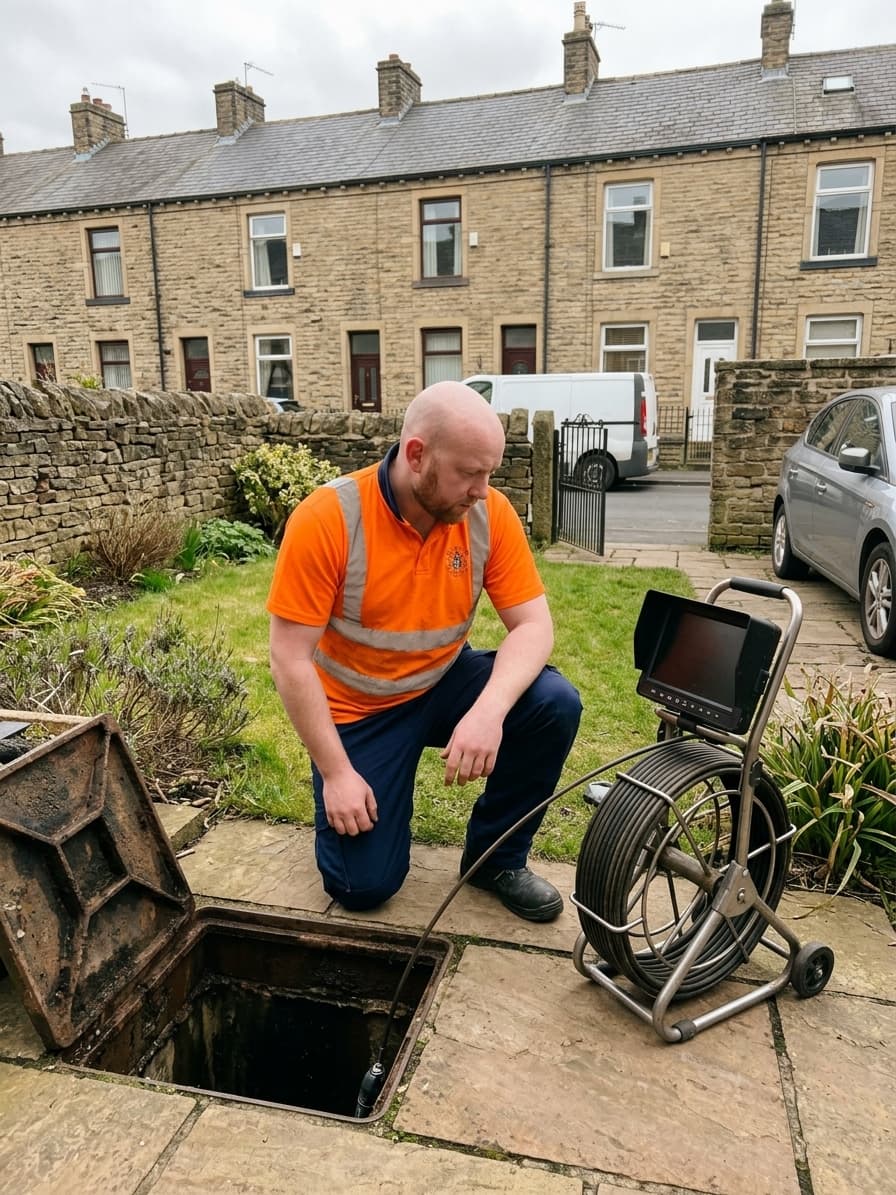
The only reliable way to diagnose a collapsed drain — rather than guessing at the cause — is a CCTV drain survey. A survey engineer feeds a push-rod or crawler camera through the inspection chamber and along the drain run, producing live video footage of the pipe interior. Collapses, fractures, root intrusions, displaced joints, and deformed pitch fibre pipes are all immediately visible on screen.
Without a camera survey, it is impossible to know the extent of the damage, the exact location, or the most appropriate repair method. Any drain contractor who quotes for a collapse repair without first carrying out a survey should be treated with caution.
If you are buying a property in Sheffield, Harrogate, Wakefield, or anywhere across Yorkshire, a homebuyer drain survey includes exactly this — a CCTV inspection designed to identify pre-existing collapse or structural damage before you exchange contracts.
How Much Does It Cost to Repair a Collapsed Drain?
Repair costs vary significantly depending on the severity of the collapse, the depth of the drain, whether it lies beneath a building or hardstanding, and the chosen repair method.
No-dig patch lining is often the most cost-effective route for localised collapses in accessible, intact sections of pipework. A resin-impregnated liner is inserted through the existing access point and cured in place, creating a new pipe within the old one — no excavation required. Full drain relining involves lining the entire pipe run rather than a single patch. It is commonly used where multiple defects exist along an older clay or pitch fibre system and costs more than patch lining, but eliminates the need to excavate a long run of garden or driveway. Excavation and replacement becomes necessary when the collapse is severe, when access is impossible with no-dig methods, or when the drain lies beneath a structure. Open-cut repairs sit at the upper end of the cost range, depending on depth, access, and reinstatement requirements.Get a CCTV Survey Before You Commit to Repairs
If you suspect a collapsed drain — or you're buying an older Yorkshire property and want certainty before exchange — the right first step is a camera survey. Yorkshire Drain Survey carries out CCTV inspections and structural assessments across the region, including Leeds, Bradford, Sheffield, Huddersfield, Wakefield, Harrogate, and beyond.
Call us on 0113 734 2245 or fill in our contact form to book a survey. We'll give you a clear picture of what's happening underground — so you can make an informed decision on the right repair.
Related guides
Drain Mapping in Yorkshire: What It Is, When You Need It & What the Survey Shows
Need drain mapping in Yorkshire? Learn what a drainage map shows, when you need one for building work, extensions, homebuying or insurance, and how CCTV tracing works.
Read guide →Blocked Drain Keeps Coming Back? Why Jetting May Not Fix the Real Problem
If your blocked drain keeps returning after jetting, there may be a deeper fault. Learn the common causes and when to book a CCTV drain survey in Yorkshire.
Read guide →The Importance of Regular Drain Maintenance in Yorkshire
Why regular drain maintenance matters for Yorkshire homes — how it prevents blockages, the warning signs to watch for, and how often to book a CCTV inspection.
Read guide →Get in touch
Need a CCTV drain survey in Yorkshire?
Same-day available. Full written report. Transparent pricing. Call us or fill in the form.