
Pitch Fibre Drains in Yorkshire: What Every Homeowner Needs to Know
Pitch fibre drains are common in Yorkshire's post-war homes and prone to failure. Find out the signs, risks, and what a CCTV survey reveals.
If your Yorkshire home was built between the 1950s and 1980s, there's a real chance your drainage system contains pitch fibre pipes — and that's worth taking seriously. Pitch fibre drains were once considered a modern alternative to clay, but decades of use have revealed a significant problem: they fail. Quietly, progressively, and often without any obvious surface sign until the damage is already serious.
Understanding what pitch fibre drains are, how they deteriorate, and how a CCTV drain survey can identify problems early could save you thousands in unplanned repair bills.
What Are Pitch Fibre Drains?
Pitch fibre pipes are made from wood cellulose impregnated with coal tar pitch — a lightweight, relatively cheap material that was widely used across the UK from the late 1940s through to the early 1980s. They were popular in new housing developments throughout Yorkshire, particularly in the large council and semi-detached housing estates built across Leeds, Bradford, Sheffield, and Wakefield during that era.
At the time, pitch fibre was seen as a practical choice. It's lighter than clay, easier to cut on-site, and resistant to certain chemicals. The problem is that it was never designed to last 70+ years — and in many Yorkshire properties, that's exactly how old these pipes now are.
How Do Pitch Fibre Drains Fail?
Why do pitch fibre pipes deteriorate over time?
Pitch fibre degrades through a process called delamination and pipe deformation. Over time, the tar pitch leaches out of the material, leaving the pipe walls soft and spongy. Ground pressure — from soil, vehicles, or tree roots — then causes the pipe to distort from its original circular shape into an oval or even a figure-of-eight. This reduces the internal bore, restricts flow, and creates ledges where debris and grease accumulate.
The process is gradual but irreversible. Hot water from washing machines and dishwashers accelerates softening. Tree root ingress, which is one of the most common drain problems across Yorkshire's mature suburban streets, can exploit even minor deformation in a pitch fibre pipe and cause rapid structural collapse. In fact, tree root ingress is widely cited as the single biggest cause of blocked drains and sewer failures in the UK — and pitch fibre is particularly vulnerable to it.
Signs that pitch fibre drains may be failing include:
- Recurring slow drainage or blockages that clear temporarily but keep returning
- Gurgling sounds from multiple appliances at once
- Damp patches or subsidence in the garden near drain runs
- Unusually lush or green grass directly above where a drain runs
- Persistent damp smells inside the property
However — and this is important — many pitch fibre drain failures produce no obvious symptoms until the pipe partially or fully collapses. A standard visual inspection from the surface simply cannot tell you what's happening underground.
How Is a Pitch Fibre Problem Diagnosed?
What does a CCTV drain survey show for pitch fibre pipes?
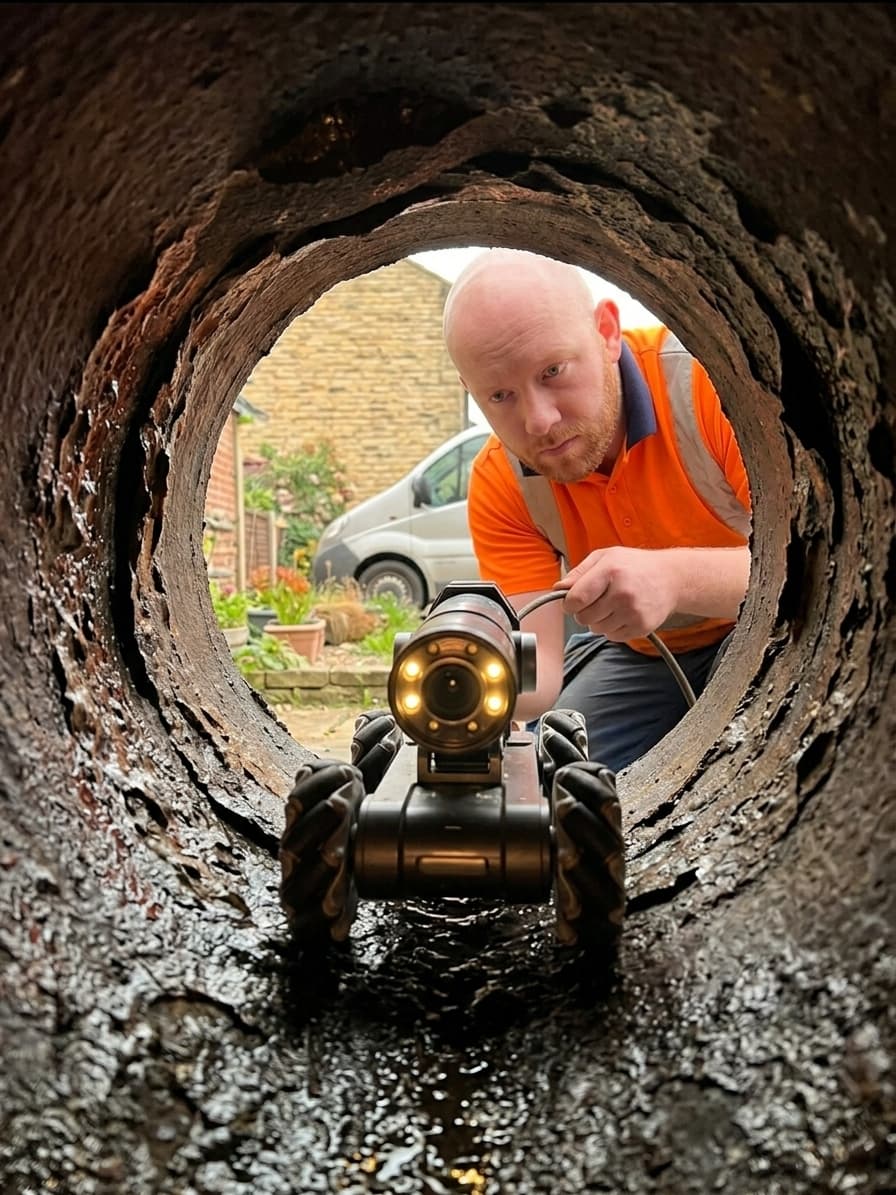
A CCTV drain survey is the only reliable method for assessing the true condition of pitch fibre drains. Our engineers insert a high-definition camera — mounted on a purpose-built crawler unit — directly into the pipe. The camera travels the full length of the drain run, transmitting live footage to a monitor above ground.
For pitch fibre specifically, the survey will reveal:
- Deformation grade — how oval or distorted the pipe has become (graded 1–5 on the industry standard WRc scale)
- Delamination — areas where the pipe wall has softened and is beginning to break apart
- Root ingress — even fine hair roots entering through joints or cracks
- Displaced joints — sections that have shifted and broken the pipe's seal
- Collapse risk — areas where failure appears imminent
Our engineers use iTouch CCTV camera systems, which deliver best-in-class image clarity in the confined space of a drain pipe. That matters: cheaper survey equipment can miss early-stage deformation or fail to capture fine root ingress, leaving problems undetected until they become emergencies.
After the survey, we provide a full written report with timestamped footage, a condition assessment for each section of pipe, and clear recommendations for any remediation required.
Do Yorkshire Homes Still Have Pitch Fibre Drains?
How common are pitch fibre drains in Yorkshire?
Very common. Yorkshire saw substantial housebuilding activity between 1945 and 1980 — the period when pitch fibre was the dominant material for private drainage runs. Estates in areas like Middleton and Seacroft in Leeds, Buttershaw and Holme Wood in Bradford, Gleadless Valley in Sheffield, and large parts of Wakefield, Pontefract, and Castleford all have significant concentrations of pitch fibre drainage.
Many homeowners in these areas have never had a drain survey and have no idea what material their drains are made from. If you purchased a home built in this era and have never had a drainage inspection, it's worth finding out — especially before planning any extension, significant landscaping, or if you're considering selling the property.
Mortgage lenders and conveyancing solicitors are increasingly flagging drainage condition as part of the home purchase process. A pre-purchase drain survey on a post-war property is now considered best practice, not an optional extra.
What Happens If Pitch Fibre Drains Are Left?
Left untreated, deformed pitch fibre pipes will eventually collapse entirely. A full drain collapse typically requires excavation — the drain run is dug up, the failed sections removed, and new pipe laid in replacement. This is disruptive and expensive work, particularly if the drain runs beneath a driveway, extension, or landscaped area.
In many cases, pitch fibre sections that have deformed but not yet collapsed can be rehabilitated using drain relining — a no-dig technique where a resin-impregnated liner is inserted and cured in place, forming a new pipe within the old one. Relining is significantly less expensive than excavation and can extend the life of a drainage system by decades. But it's only an option if the damage is caught before full collapse.
This is precisely why early detection through a CCTV survey is so important. The difference between a relined drain and an excavated one can be measured in thousands of pounds.
Get a Pitch Fibre Drain Survey in Yorkshire
If your home was built between 1950 and 1980 — or if you're buying one — a drainage survey should be on your checklist. Our experienced engineers cover the whole of Yorkshire, including Leeds, Bradford, Sheffield, Wakefield, Harrogate, Huddersfield, Doncaster, and York.
We use professional-grade iTouch CCTV equipment and provide clear upfront pricing before any work begins. Call 0113 734 2245 for a quote, or fill in our contact form and we'll be in touch promptly.
Don't wait for a symptom. Find out what's actually down there.
Related guides
How to Prevent Blocked Drains in Yorkshire
Practical tips to prevent blocked drains in Yorkshire homes — what causes blockages, the early warning signs, and how regular maintenance keeps drains flowing.
Read guide →Blocked Drains in Yorkshire: Causes, Costs, and How to Clear Them
Blocked drains in Yorkshire? Understand the common causes — fat, roots, collapsed clay pipe — what it actually costs to clear them, who's responsible, and how a CCTV survey stops the problem coming back. Local guide for LS/BD/S/HU postcodes.
Read guide →Smelly Drains in Yorkshire? Causes, Health Risks & How to Fix Them
Smelly drains in Yorkshire homes are more than a nuisance. Learn what causes drain smells, when they're dangerous, and how a CCTV survey finds the source.
Read guide →Get in touch
Need a CCTV drain survey in Yorkshire?
Same-day available. Full written report. Transparent pricing. Call us or fill in the form.