
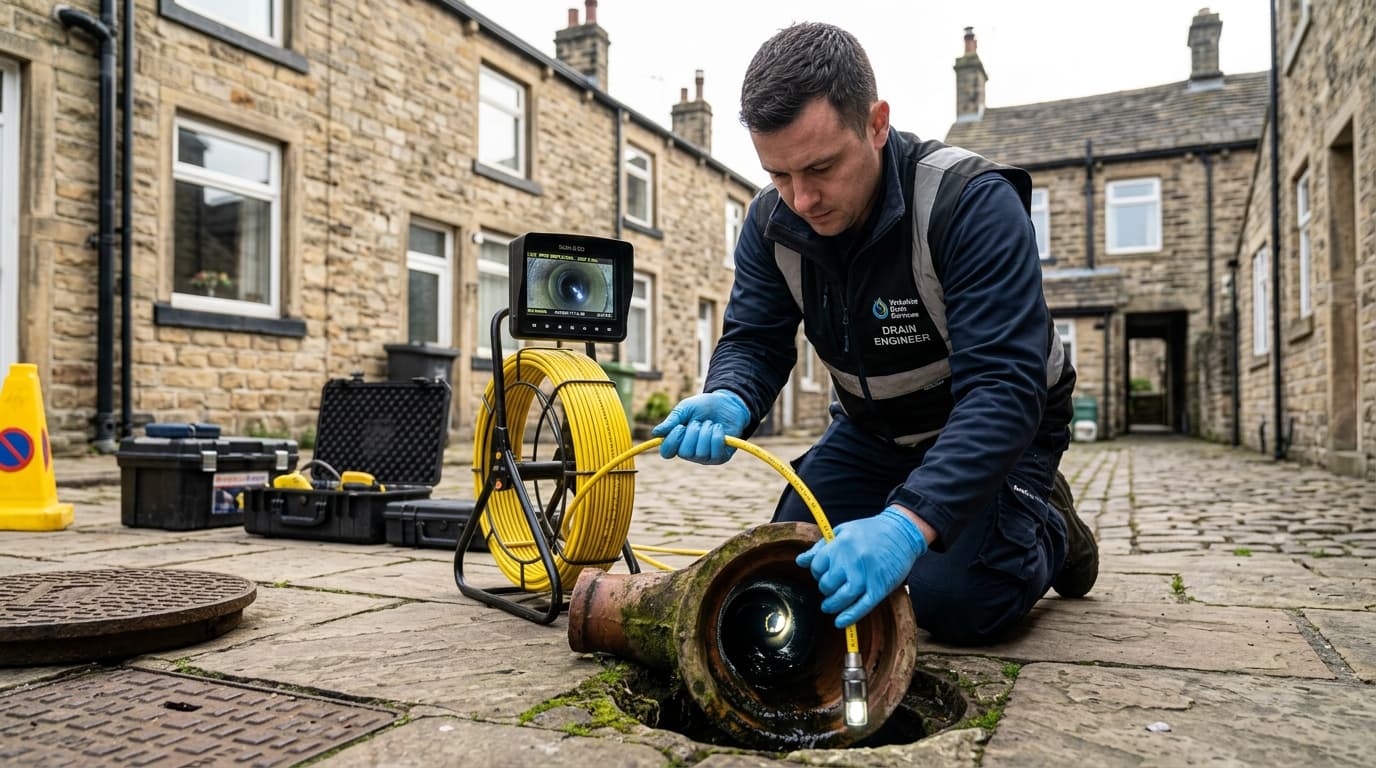
How Does a CCTV Drain Survey Work?
Wondering what actually happens during a CCTV drain survey? Here's a clear, step-by-step guide to the process — from arrival to final report.
What Happens During a CCTV Drain Survey?
1. Access point identification
The engineer arrives and locates the drain access points — typically inspection chambers (manhole covers) in the garden, driveway, or near the property boundary. For most domestic properties in Yorkshire, there are one or two access points serving the main drainage runs.
If access points are buried or blocked, the engineer may need to clear or lift a cover first. This is common in older properties where chambers have been paved over.
2. Camera insertion
A high-definition, waterproof CCTV camera is attached to a flexible push-rod or crawler unit and fed into the drain. The camera transmits live footage back to a monitor the engineer watches in real time.
The camera is rated to work inside pipes ranging from 75mm to 600mm in diameter — covering the standard domestic drainage pipes found in Yorkshire homes, through to larger commercial systems.
3. The survey run
The engineer guides the camera through the drainage run — typically covering the underground pipework from the property out to the main sewer connection. As the camera travels through, it records footage continuously.
The engineer notes the position, nature, and severity of any defects found, using distance counters on the equipment to log exactly where in the pipe each issue occurs.
4. What the engineer is looking for
During the survey run, the engineer checks for:
- Cracks and fractures — structural damage to the pipe wall
- Root ingress — tree and shrub roots penetrating through joints or cracks
- Displaced or offset joints — sections of pipe that have shifted, creating a step in the flow path
- Pipe collapse — partial or full collapse of the pipe structure
- Sags and bellying — low points where water and debris pool rather than draining away
- Blockages and build-up — grease, silt, debris, or foreign objects obstructing the pipe
- Incorrect connections — drainage from different sources connected to the wrong system
- Shared drainage — identifying whether neighbouring properties' drains pass through the same system
5. Report and video footage
After the survey, you receive a full written report and the video footage. The report includes:
- A condition rating for each section of pipe surveyed
- The location of any defects (measured distance from the access point)
- Photographs and video evidence
- Recommendations for any remedial work required
Most reports are turned around within 24–48 hours. The video footage is yours to keep and can be shared with solicitors, insurers, or contractors.
How Long Does a CCTV Drain Survey Take?
A standard domestic CCTV drain survey takes 1–2 hours on site. Larger properties, commercial sites, or systems with multiple drainage runs will take longer — typically 2–4 hours. See our full guide on how long a drain survey takes for the variables that affect duration.
Does the Survey Require Any Preparation?
No special preparation is needed. You don't need to clear drains beforehand. The engineer will need access to the inspection chambers, so ensure garden gates are unlocked and parked vehicles aren't blocking access to driveway chambers.
If the property is tenanted, the occupant doesn't need to be in — chamber access is external for most properties.
What Faults Can a CCTV Survey Detect?
CCTV surveys can detect virtually any structural or blockage-related fault inside the pipe, including damage that's invisible from the surface. The only limitation is sections of pipework with no access point — if a pipe section has no chamber at either end, a camera can't enter it. This is uncommon in standard residential drainage.
For a detailed walkthrough of the report and what to do with the findings, see what happens after a CCTV drain survey.
When Is a CCTV Drain Survey Used?
Common situations where a CCTV drain survey is the right tool:
- Before buying a property — to check the drainage condition before exchange of contracts
- Recurring blockages — to find the root cause rather than repeatedly clearing symptoms
- Slow drainage — to diagnose whether the issue is a blockage, a sag, or a structural fault
- Before a home extension — to check for drains in the build footprint (build over survey)
- Insurance claims — to produce evidence of damage for a claim
- Landlord inspections — to document drainage condition at the start or end of a tenancy
Book a CCTV Drain Survey in Yorkshire
We cover all of Yorkshire — Leeds, Bradford, Harrogate, Wakefield, York, Sheffield, Huddersfield, Doncaster, and surrounding areas.
Call us on 0113 734 2245 or get a quote online. Surveys typically available within 48 hours.Related guides
What's the Difference Between a CCTV Drain Survey and a Drain Inspection?
CCTV drain survey vs drain inspection — are they the same thing? Here's the clear distinction, when each is used, and which one you need.
Read guide →What Happens After a CCTV Drain Survey?
What happens after a CCTV drain survey: report walkthrough, the next steps, and the repair options for any defects found. Clear, jargon-free guide.
Read guide →What Does a CCTV Drain Survey Show?
Find out exactly what a CCTV drain survey can detect — from root ingress and pipe collapse to misaligned joints and illegal connections.
Read guide →Get in touch
Need a CCTV drain survey in Yorkshire?
Same-day available. Full written report. Transparent pricing. Call us or fill in the form.